


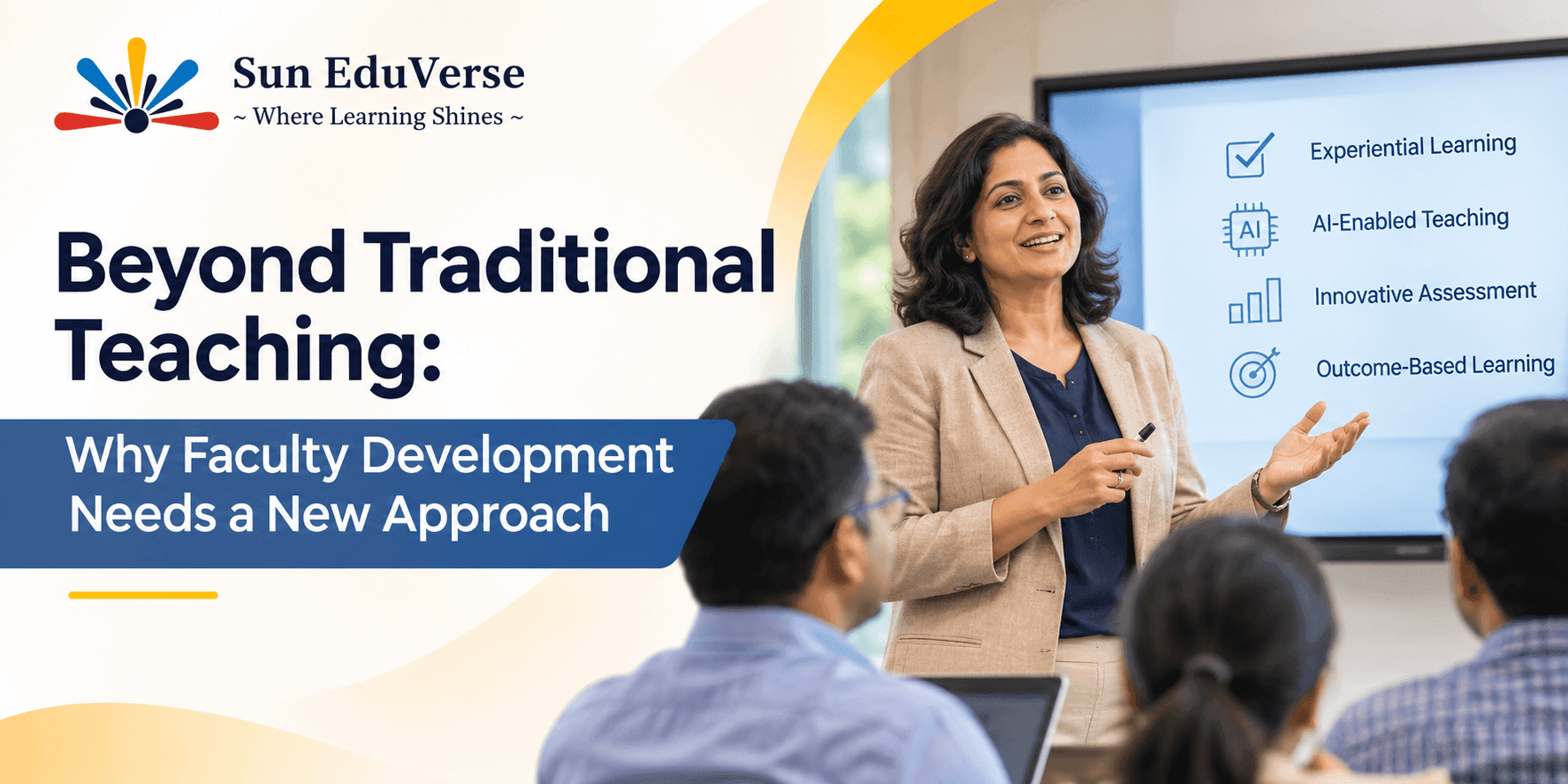
Moving from knowledge dissemination to learner engagement, practical application and measurable educational outcomes.
Higher education is undergoing a significant transformation. Students have greater access to information, digital technologies are reshaping learning experiences, and employers increasingly expect graduates to demonstrate practical capabilities alongside academic knowledge.
Yet, despite these changes, teaching practices in many institutions continue to rely heavily on conventional lectures, content delivery and examinations.
Lectures remain valuable for explaining complex concepts and building disciplinary foundations. However, effective teaching today requires more than subject expertise and the ability to communicate information. It demands the ability to engage learners, encourage critical thinking, integrate technology meaningfully and assess whether students can apply what they have learned.
This raises an important question for higher education institutions: Are traditional Faculty Development Programs (FDPs) sufficiently preparing educators for these evolving expectations?
The answer lies not in organising more training programs, but in fundamentally reconsidering how faculty development is designed, delivered and evaluated.
1. Move Beyond Content Delivery to Learning Facilitation
Traditional teaching often positions faculty members as the primary source of knowledge. Students attend lectures, take notes and demonstrate their understanding through examinations.
While this approach can support foundational learning, it may provide limited opportunities for students to question assumptions, explore alternative perspectives or solve unfamiliar problems.
Contemporary teaching requires faculty members to function not only as subject experts but also as facilitators of meaningful learning experiences.
Case discussions, problem-based learning, simulations, collaborative activities and guided inquiry can encourage students to participate actively and connect concepts with practical situations.
For example, rather than simply explaining customer segmentation, a marketing faculty member could ask students to evaluate competing segmentation strategies for an emerging business and justify their recommendations.
What institutions can do differently: Design FDPs that help educators transform existing course content into participative, application-oriented learning experiences.
The objective should be to strengthen learning effectiveness without compromising academic rigour or disciplinary depth.
2. Make Faculty Development Experiential Rather Than Instructional
Faculty development itself must reflect the teaching practices institutions wish to promote.
A workshop on active learning that consists entirely of lectures creates a disconnect between its stated purpose and delivery methodology.
Faculty members benefit from opportunities to experience innovative teaching approaches, experiment with instructional techniques and receive constructive feedback.
For instance, an FDP on experiential pedagogy could require participants to redesign an existing classroom activity, facilitate a short learning session and evaluate its effectiveness through peer observations.
Such experiences move faculty development beyond awareness towards actual instructional competence.
What institutions can do differently: Incorporate microteaching, classroom simulations, peer learning, lesson-plan redesign and practical demonstrations into faculty development initiatives.
Every FDP should ideally conclude with a tangible teaching resource or classroom implementation plan.
3. Integrate AI into Teaching with Purpose and Judgement
Artificial intelligence is creating new possibilities for instructional planning, content development, personalised learning support and assessment.
Faculty members can use generative AI to develop teaching scenarios, explore alternative explanations, design formative assessments and create discipline-specific learning activities.
However, technology adoption should not become an objective in itself.
AI-generated content may contain inaccuracies, unsupported claims or inappropriate assumptions. Excessive reliance on automated tools can also weaken critical thinking and independent judgement.
Faculty development must therefore address two complementary capabilities: using AI effectively and evaluating AI outputs critically.
Educators need practical guidance on responsible AI use, academic integrity, student data privacy, assessment redesign and the appropriate boundaries of automation.
What institutions can do differently: Introduce hands-on AI-enabled pedagogy workshops where faculty members develop, test and critically review instructional materials for their own courses.
Successful AI integration should be measured by improvements in teaching effectiveness and learning experiences, not merely by the number of tools adopted.
4. Strengthen Assessment Design and Outcome-Based Learning
One of the most important responsibilities of an educator is determining whether meaningful learning has occurred.
Traditional examinations often emphasise conceptual understanding and knowledge recall. These remain necessary, but they may not adequately capture students’ ability to apply concepts, analyse situations or exercise professional judgement.
Faculty development should equip educators to design assessments that evaluate different levels of learning.
These may include case analyses, applied projects, presentations, reflective assignments, simulations and authentic problem-solving tasks.
Well-designed rubrics can make expectations clearer and provide students with actionable feedback.
For example, a student presentation should not be evaluated solely on delivery. Assessment criteria could also examine conceptual accuracy, quality of evidence, analytical reasoning and the relevance of recommendations.
What institutions can do differently: Align FDPs with outcome-based education by requiring faculty members to review learning objectives, redesign assessment tasks and establish measurable evaluation criteria.
The emphasis must shift from simply completing the syllabus to demonstrating achievement of intended learning outcomes.
5. Connect Classroom Learning with Industry Expectations
Higher education must develop disciplinary expertise while preparing students to apply that knowledge in changing professional environments.
This requires faculty members to remain connected with evolving industry practices, technological developments and workplace expectations.
However, industry integration should extend beyond inviting guest speakers or organising occasional industrial visits.
Faculty members should be encouraged to incorporate contemporary business problems, professional scenarios, practical projects and interdisciplinary perspectives into their courses.
Collaboration with industry practitioners and academic leaders with professional experience can provide valuable insights into how theoretical knowledge is applied in real organizational settings.
What institutions can do differently: Include industry-informed curriculum enrichment, applied case development and practical project design in faculty development initiatives.
The objective is not to convert higher education into narrow job training, but to make academic knowledge more relevant, transferable and applicable.
6. Replace One-Time Workshops with Continuous Faculty Development
Faculty development is often organized as an annual or semester-based activity, with success measured through participation and feedback.
However, attending a workshop does not automatically translate into sustained improvement in classroom practices.
Faculty members need opportunities to experiment, reflect, receive feedback and refine their instructional approaches over time.
A structured development journey can include baseline assessment, focused workshops, guided implementation, peer observation and follow-up reviews.
Institutions can also establish faculty learning communities where educators share classroom experiences, discuss challenges and collectively develop solutions.
What institutions can do differently: Introduce continuous faculty development pathways linked to institutional teaching priorities and individual development needs.
This approach makes professional development an ongoing process rather than an isolated institutional requirement.
7. Measure Faculty Development Through Classroom Impact
Participation certificates, attendance records and satisfaction scores confirm that a program was delivered. They do not necessarily establish whether teaching practices have improved.
Institutions should adopt a more comprehensive assessment approach.
| Evaluation Dimension | Illustrative Evidence |
| Faculty learning | Pre- and post-assessments, practical demonstrations |
| Teaching innovation | Redesigned lesson plans, classroom activities and teaching resources |
| Classroom implementation | Peer observations, implementation records and reflective reviews |
| Assessment improvement | Revised rubrics, authentic assessments and feedback practices |
| Student learning experience | Student feedback, participation evidence and relevant learning outcomes |
Not every intervention requires extensive measurement. Institutions should identify indicators appropriate to the program’s objectives and duration.
Importantly, changes in student performance are influenced by multiple factors. Evaluation should therefore examine the contribution of faculty development without automatically attributing every outcome to a single training intervention.
A More Effective Faculty Development Framework
Faculty development becomes more meaningful when it follows a structured process that connects professional learning with classroom application.
At Sun EduVerse, our approach emphasizes four interconnected stages:
Assess → Learn → Practice → Demonstrate
Assess: Identify faculty development priorities, instructional challenges and institutional expectations.
Learn: Introduce relevant pedagogical approaches, contemporary practices and technology-enabled learning strategies.
Practice: Engage faculty members in lesson redesign, simulations, collaborative exercises and guided application.
Demonstrate: Evaluate learning through teaching resources, practical demonstrations, implementation plans and constructive feedback.
This methodology can be delivered through intensive workshops, modular FDPs, blended learning, faculty mentoring and structured follow-up interventions.
The emphasis remains on translating professional development into observable teaching capabilities.
The Way Forward: From Faculty Training to Institutional Learning Excellence
The future of higher education depends not only on curriculum relevance, infrastructure or technology adoption, but also on the capabilities of educators who shape students’ learning experiences.
Faculty development must therefore evolve from a compliance-oriented activity into a strategic institutional priority.
This requires academic leaders to invest in programs that strengthen pedagogical competence, encourage responsible technology adoption, improve assessment practices and promote meaningful learning.
Equally important is creating an institutional environment where faculty members have the support, autonomy, and opportunities needed to experiment with improved teaching approaches.
The true value of faculty development lies not in the number of workshops conducted, but in the quality of teaching practices transformed and the learning experiences improved.
Institutions that embrace this shift will be better positioned to develop engaged learners, strengthen academic effectiveness and prepare graduates for an increasingly complex world.
How Sun EduVerse Supports Faculty Development
Sun EduVerse partners with higher education institutions to design customized, outcome-driven Faculty Development Programs focused on contemporary pedagogy, experiential learning, AI-enabled teaching, assessment innovation and academic effectiveness.
Drawing upon the expertise of Industry Practitioners, Practitioner–Academic Leaders, IIM Alumni, and Domain Experts, our interventions combine academic perspectives with practical application, flexible learning formats, and evidence-based evaluation.
Looking to strengthen faculty capabilities and enhance teaching effectiveness at your institution?